Schema vs Scheme: What’s the Difference? Meaning, Examples and Uses
A developer asks you to “update the database scheme.” A friend warns you about a “get-rich-quick schema.” Both sound almost right, yet both are wrong. The words look alike, sound alike, and even share the same ancestor, so it is easy to swap them by mistake.
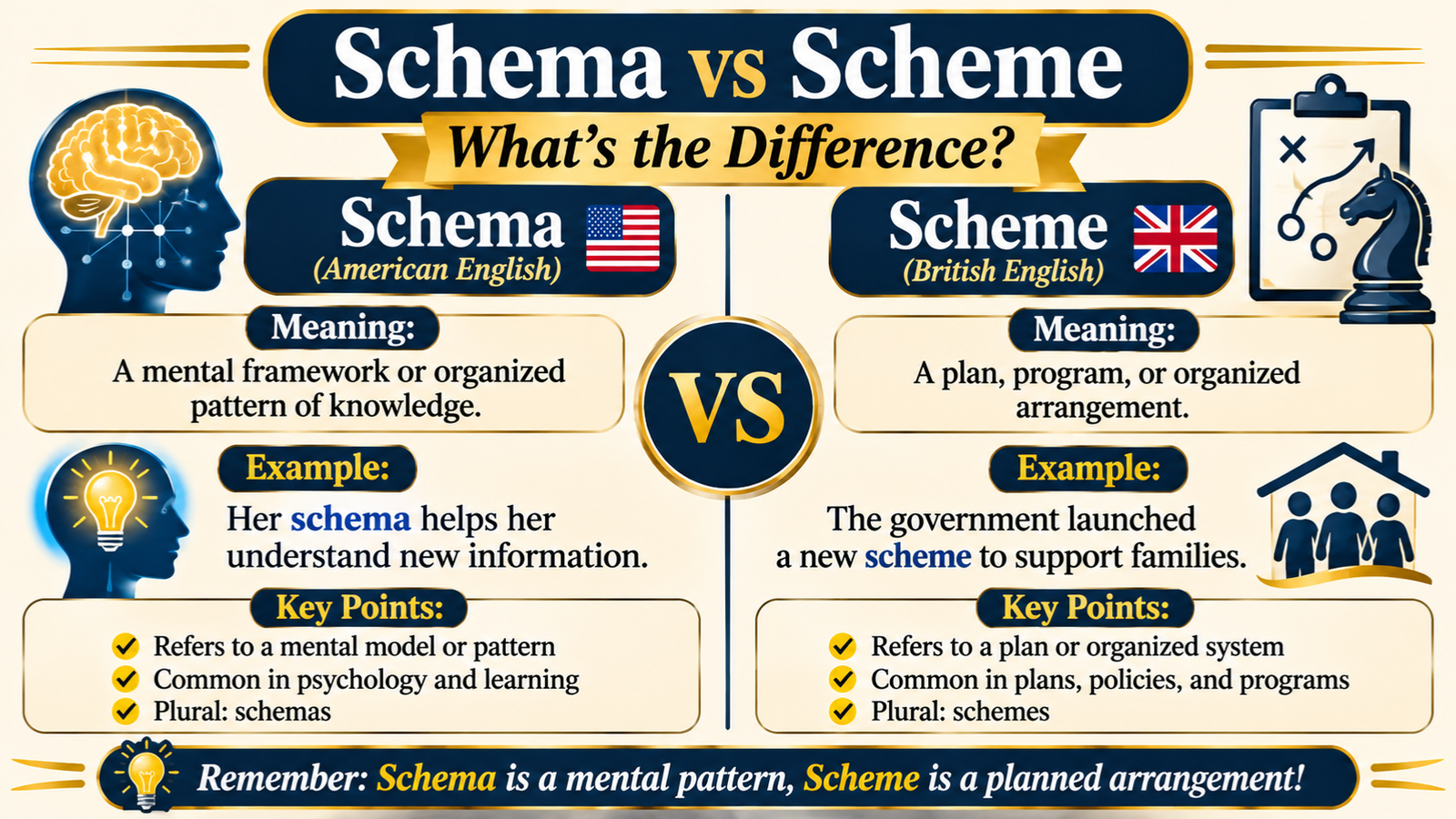
The Schema vs Scheme question comes down to this: schema is a structure or framework (how something is organized), while scheme is a plan or arrangement (what someone intends to do), and sometimes a secret plot. In this guide, you will learn the meaning of each word, their shared Greek origin, how to pronounce them, the plural forms, and how they are used in databases, SEO, psychology, government, business, and design. You will also see common mistakes, a simple test, and easy memory tricks that make Schema vs Scheme a problem you never have to think about again.
Schema vs Scheme: Quick Answer
Schema means a structure, framework, or outline, such as a database schema or a mental schema. Scheme means a plan, program, or arrangement, such as a color scheme, or a secret plot, such as a fraud scheme. Both words come from the same Greek root, but they do different jobs.
| Word | Core idea | Example |
| schema | structure or framework | The database schema lists every table. |
| scheme | plan, arrangement, or plot | The council launched a new housing scheme. |
Quick examples:
- The developer updated the database schema.
- Children build mental schemas through experience.
- The government introduced a new housing scheme.
- We chose a blue and white color scheme.
What Does “Schema” Mean?
Schema is a noun. It describes the underlying structure, outline, or pattern of something, often an abstract one. It is a neutral, technical word, and it usually answers the question: how is this organized?
Dictionaries list these main meanings:
- A diagram, plan, or outline.
- An underlying organizational pattern or conceptual framework.
- In psychology, a mental model of the world or of oneself.
- In logic, an expression with placeholder variables that can be replaced to form complete statements.
- In computing, a formal description of how data is organized, such as the tables and columns in a database.
- In Kant’s philosophy, a specialist term that dictionaries describe as similar to a universal concept but limited to our experience of the world.
Examples of “schema”:
- The database schema defines every table, column, and data type.
- An XML schema checks that a file follows the right format.
- The teacher drew a schema of the water cycle on the board.
- A child builds a schema for “dog” from the animals she meets.
- The developer changed the schema before adding the new feature.
- Add schema markup to your page so search engines can read it.
- The author used a simple schema to organize the chapters.
- Her schema of how a meeting works made the new office confusing.
- The researchers described a schema for how readers remember stories.
What Does “Scheme” Mean?
Scheme is both a noun and a verb, and its meanings are more varied.
As a noun:
- A plan or program of action. (“a savings scheme”)
- A secret or underhanded plot. (“a fraud scheme”)
- A systematic arrangement of related parts. (“a color scheme,” “a rhyme scheme”)
- An officially adopted plan by a government or company. (“a pension scheme”)
- A chart, diagram, or outline.
As a verb: to make plans, often secretly or deceitfully, or to devise a plan.
Examples of “scheme”:
- The company’s pension scheme is very successful.
- The police broke up a fraud scheme that targeted older people.
- The room has a calm blue and gray color scheme.
- The poem follows an ABAB rhyme scheme.
- She schemed for months to win the promotion.
- The government announced a new scheme to help first-time buyers.
- Our office adopted a new filing scheme.
- The city started a recycling scheme.
- They were caught scheming behind the manager’s back.
Schema vs Scheme: The Core Difference Explained
The simplest way to see the Schema vs Scheme difference is to ask what kind of thing you are describing.
- Schema = structure. It answers: How is this organized?
- Scheme = plan. It answers: What is being planned, arranged, or plotted?
| If you mean… | Use | Example |
| how a database is organized | schema | database schema |
| how a mind organizes knowledge | schema | mental schema |
| code that labels web content for search engines | schema | schema markup |
| a plan someone made | scheme | a savings scheme |
| a pattern of colors | scheme | color scheme |
| a deceptive plot | scheme | a pyramid scheme |
| to plot or plan | scheme (verb) | They schemed to win. |
Notice that “schema” is never a verb in standard English. If you want a verb, you need scheme (schemed, scheming).
A simple substitution test: Replace the word with framework. If the sentence still makes sense, use schema. Now replace it with plan. If that works better, use scheme.
- “The database ___ lists all tables.” Framework fits, so schema.
- “The council announced a new housing ___.” Plan fits, so scheme.
The two words overlap slightly because “scheme” can also mean “a chart, diagram, or outline,” which is close to “schema.” But in modern English, each has settled into its own territory.
Schema vs Scheme Comparison Table
This quick table sums up Schema vs Scheme:
| Feature | Schema | Scheme |
| Main meaning | Structure, framework, outline | Plan, arrangement, plot |
| Part of speech | Noun | Noun and verb |
| Tone | Neutral, technical | Neutral or negative, depending on context |
| Pronunciation | SKEE-muh | SKEEM |
| Plural | schemas, schemata | schemes |
| Typical fields | Databases, SEO, psychology, logic | Business, government, design, everyday life |
| Common phrases | database schema, schema markup, mental schema | color scheme, pension scheme, pyramid scheme |
| Everyday frequency | Less common outside technical fields | Very common |
| Example | The schema shows how the tables connect. | The scheme was meant to cheat investors. |
Word Origin: Why the Two Words Are Related
Both words go back to the same Greek word, skhēma (also written schêma), meaning “form, shape, or figure.”
- Scheme came into English first. Dictionaries trace it through Medieval Latin schēma and record it in the 1500s.
- Schema was borrowed later, directly from the Latin and Greek form. Dictionary.com records it around 1790 to 1800.
The shared source is why Schema vs Scheme looks so confusing. The two words are called doublets: different words that grew from the same root. Over time, “scheme” took on the sense of a plan or plot, while “schema” kept the older, more abstract sense of form and structure.
This history also explains the “sk” sound in both words. The “ch” here comes from the Greek letter chi, which English often spells as “ch” but pronounces like “k,” as in school, chorus, and character.
Pronunciation
In speech, Schema vs Scheme is a small difference. Both words begin with a hard “sk” sound, not “sh.” The “ch” is pronounced like “k.”
| Word | American | British | Stress |
| schema | SKEE-muh (/ˈskimə/) | /ˈskiːmə/ | first syllable |
| scheme | SKEEM (/skim/) | /skiːm/ | one syllable |
Pronunciation tips:
- If you say “SHEE-muh,” you are using the wrong sound. Think of school: the “sch” sounds like “sk.”
- Schema has two syllables and ends in a soft “muh.” Scheme has one syllable and ends sharply with “m.”
- Say them aloud a few times: SKEE-muh, SKEEM. The difference in length helps you remember that schema is the longer, more technical word.
Plural Forms: Schemas, Schemata and Schemes
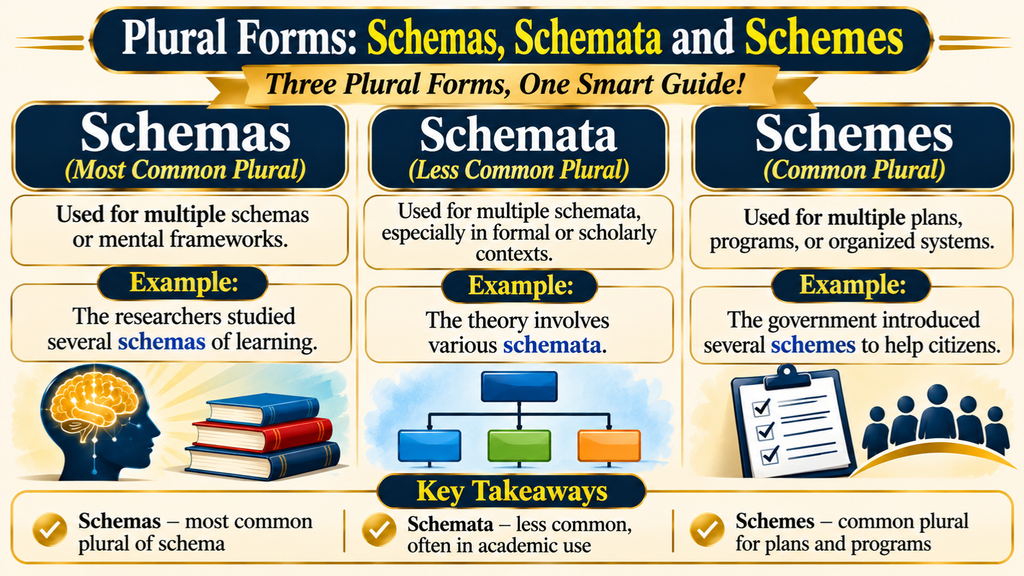
The plural is another place where Schema vs Scheme differs. Scheme has a plain plural: schemes.
Schema has two accepted plurals:
- schemas: the common modern choice, especially in everyday and technical writing
- schemata: the older, Greek-style plural, more common in formal, scientific, or philosophical writing
Both are correct. Pick one and keep it consistent throughout your document.
| Singular | Plural |
| schema | schemas / schemata |
| scheme | schemes |
Many English words with Greek or Latin roots have unusual plurals. If you enjoy this topic, see our guides on criteria vs criterion, forums vs fora, and die vs dice.
Schema vs Scheme in Databases and Data Formats
Technology is where the Schema vs Scheme confusion causes the most trouble, because both words appear in tech with different meanings. Start with schema, which has a precise technical job.
Database Schema
In a database, the schema is the blueprint. It describes the table names, the column names, each column’s data type, and how the tables connect. It often also covers keys and rules that keep data consistent. You may hear “schema design,” “schema change,” or “schema migration.”
Think of an online bookstore. Its schema might include these tables:
| Table | What it stores |
| Customers | customer profiles |
| Books | book details |
| Orders | purchase records |
| Payments | payment history |
The schema explains what each table holds and how the tables are linked, for example, which customer placed which order.
- Correct: We need to update the database schema.
- Incorrect: We need to update the database scheme.
A well-designed schema helps developers reduce duplicate data, keep information consistent, and prevent errors. That is why professionals say database schema, never “database scheme.”
XML and JSON Schema
A schema is also a formal description of how a data file should look. An XML schema describes the allowed structure of an XML file, such as required elements, allowed attributes, and data types. JSON Schema does a similar job for JSON data. If a file does not follow the schema, it fails validation.
Schema Markup and Schema.org: Schema vs Scheme in SEO
In SEO, schema markup is structured data added to a web page. It labels content, such as an article, recipe, product, or FAQ, so that search engines can understand it better.
Google explains that structured data is a standardized format that describes a page’s information, and that structured data for Search mainly uses the schema.org vocabulary. Google supports three formats: JSON-LD, microdata, and RDFa, and it generally recommends JSON-LD in most cases. JSON-LD is a JavaScript notation placed inside a <script> tag in the page’s HTML.
Here is why this matters for the Schema vs Scheme choice: the correct SEO terms are schema markup and schema.org. “Scheme markup” is a mistake. The word schema here means a shared structure for describing things, which fits the core meaning perfectly.
A note on expectations: Structured data helps search engines understand a page. It is not a promise of higher rankings, so use it to describe your content accurately rather than to chase results.
Where “Scheme” Appears in Technology
“Scheme” is also a real word in technology, but it means something different. This is one reason Schema vs Scheme trips people up in technical writing.
URL and URI Scheme
The scheme is the first part of a web address, the part before the colon. It tells software how to interpret the rest. The standard that defines this, RFC 3986, says a scheme starts with a letter and may then contain letters, digits, plus signs, periods, or hyphens. Examples include http, https, ftp, and mailto.
In https://clearpenpress.com, the scheme is https.
Color Scheme
In design and software, a color scheme is the set of colors used together, such as a dark mode palette. Never write “color schema.”
Scheme (Programming Language)
Scheme is also the name of a programming language. It is a dialect of Lisp, created by Guy Steele and Gerald Sussman at MIT in the 1970s, and it first appeared in 1975. It was originally called “Schemer,” and the name was shortened because of filename limits on the computer system the authors used.
The language name is a proper noun and has nothing to do with databases or data structures.
For another pair of short tech-related words that people often confuse, see our guide to lag vs log.
Schema in Psychology, Education and Learning
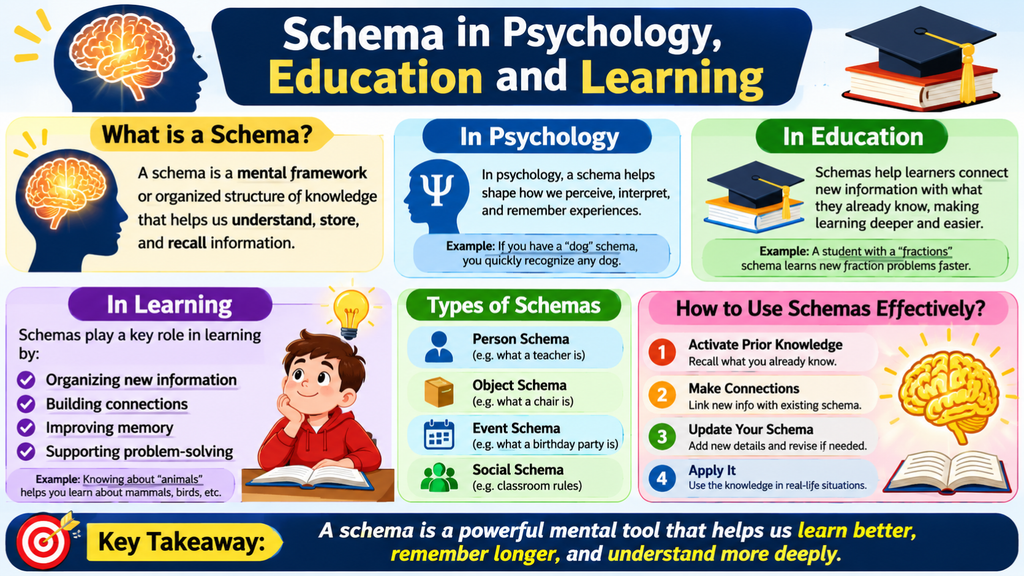
In psychology, the Schema vs Scheme question is settled: a schema is a mental structure that organizes what we know about a person, object, or event, built from past experience. It helps the brain process new information quickly by supplying expected details.
Schema theory has two famous names:
- F. C. Bartlett studied schemas in depth in his 1932 book Remembering. He argued that remembering rebuilds the past from existing schemas.
- Jean Piaget added schemas to a theory of child development, seeing them as mental structures that change with new information.
Assimilation and Accommodation
Piaget described two ways a schema responds to new information:
- Assimilation: new information fits into an existing schema, and the schema stays the same.
- Accommodation: the schema changes, or a new one forms, because the new information does not fit.
Example: A child has a “bird” schema based on robins. Seeing a sparrow is assimilation, because the schema already fits. Seeing a penguin, which cannot fly, may force accommodation, because the child must adjust the schema.
Common Types of Schemas
| Type | What it organizes | Example |
| Role schema | expected behavior for a social position | what a waiter or doctor does |
| Event schema (script) | the usual sequence of an event | eating at a restaurant |
| Self schema | knowledge about yourself | seeing yourself as organized |
| Object schema | how objects work | knowing how a bicycle is used |
Schema in Education
Teachers use the idea of schema every day. Students understand new material more easily when they connect it to something they already know. A teacher who asks “Where does rain come from?” before explaining the water cycle is activating students’ existing schemas.
Schemas also have a downside: relying too heavily on an existing mental framework can lead to bias or incorrect assumptions.
In psychology and education, the correct word is always schema, with the plural schemas or schemata. Writing “mental scheme” is a mistake.
Schema in Logic, Linguistics and Philosophy
These are specialist uses, and you will meet them mostly in academic texts.
- Logic: A schema is a pattern with placeholder variables. Replace the placeholders with real terms or statements, and you get specific, complete statements.
- Linguistics: The word can describe a recurring pattern, such as a common sentence pattern that speakers recognize automatically.
- Philosophy: “Schema” has a special use in Kant’s philosophy, where it links abstract concepts to experience.
In all three fields, the central idea stays the same: a schema provides structure, not a plan of action.
Schema vs Scheme in Government, Business and Daily Life
Outside technology and psychology, you will meet scheme far more often than schema. This is where the Schema vs Scheme choice almost always goes to scheme.
Plans and Programs
A scheme can be an official plan. Dictionaries define one sense of scheme as a plan or policy officially adopted by a government or business, such as a pension scheme. Common examples include:
- savings scheme
- housing scheme
- scholarship scheme
- training scheme
- recycling scheme
- loyalty or reward scheme
In British English, and in many other regions, “scheme” is a normal, neutral word for an official program. In American English, it more often sounds sneaky or negative. Context tells you which tone is meant.
Programs like these often release money in stages, which is the topic of our guide to the disbursement meaning.
Organized Systems
Sometimes “scheme” means the way something is arranged, not a plan of action:
- naming scheme: a consistent way to name files or products
- classification scheme: a system for sorting items into groups
- filing scheme: an organized way to store documents
- coding scheme: a system of codes used to label information
Color and Rhyme
- Color scheme: the set of colors in a design or room, such as navy and white or earth tones.
- Rhyme scheme: the pattern of rhymes in a poem, such as ABAB.
As a Verb
Only scheme works as a verb: She schemed to get the job. The matching adjective is scheming, meaning crafty or plotting, and a person who does this is a schemer.
Scheme as a Dishonest Plot
Not every scheme is positive. A scheme can also be a secret or dishonest plan meant to benefit someone unfairly. This is the sense that gives the word its suspicious reputation.
The U.S. Securities and Exchange Commission’s investor education site describes a pyramid scheme as an investment fraud in which new participants’ fees are typically used to pay existing participants for recruiting new members. Other well-known examples include:
- Ponzi scheme: a type of investment fraud
- fraud scheme: any dishonest plan to cheat people
- get-rich-quick scheme: a plan that promises easy money
Example: Investigators uncovered a scheme that cheated thousands of savers.
Scams succeed by looking genuine, so it helps to know the difference between something real and something that only claims to be. Our guide to real vs authentic explains that distinction.
Remember that the word does not always imply dishonesty. A “community housing scheme” is a positive program, while an “illegal investment scheme” is a crime. The surrounding words decide the tone.
Why People Confuse Schema vs Scheme
The confusion is natural. Several factors contribute to it.
- Shared origin. Both words come from the Greek skhēma, so they resemble each other.
- Similar pronunciation. Both start with “SKEE.” Only the ending differs.
- Similar spelling. Only two letters separate them, so it is easy to type one for the other.
- Familiarity. Most people meet scheme in daily life but meet schema only in psychology, education, or computing, so some writers use scheme where it does not belong.
- Overlap in tech. Both words appear in technology: schema for data structure and scheme for URL schemes and color schemes.
- Overlap in meaning. One old sense of “scheme” is “a chart, diagram, or outline,” which is close to “schema.”
Common Expressions With Schema and Scheme
With “scheme”:
| Expression | Meaning |
| color scheme | a coordinated set of colors |
| pension scheme | an official retirement savings plan |
| housing scheme | a program that provides homes |
| reward scheme | a customer incentive program |
| rhyme scheme | the pattern of rhymes in a poem |
| naming scheme | a consistent way of naming things |
| pyramid scheme | an investment fraud based on recruiting |
With “schema”:
| Expression | Meaning |
| database schema | the structure of a database |
| XML schema | rules that define a valid XML file |
| schema markup | structured data that labels web content |
| schema theory | the idea that people organize knowledge into mental frameworks |
| mental schema | a framework in the mind |
| self schema | knowledge a person has about themselves |
| conceptual schema | a high-level representation of a system |
Related Word Forms
Each side of Schema vs Scheme has its own small word family:
| Word | Part of speech | Example |
| schema | noun | The schema shows how the data is organized. |
| schemas / schemata | noun (plural) | The two schemas do not match. |
| schematic | adjective / noun | The engineer drew a schematic of the circuit. |
| schematically | adverb | The process is shown schematically. |
| scheme | noun / verb | They devised a scheme to save money. |
| schemes | noun (plural) / verb | She schemes against her rivals. |
| schemed | verb (past) | He schemed for years. |
| scheming | adjective / verb | The scheming manager hid the facts. |
| schemer | noun | The schemer was finally exposed. |
Note: “Schematic” is related to schema, since a schematic is a diagram that shows structure.
Synonyms
Synonyms show clearly how far apart Schema vs Scheme really is.
Synonyms for schema:
- framework
- structure
- blueprint
- model
- outline
Synonyms for scheme:
- plan
- program
- design
- arrangement
- plot (when it is secret or dishonest)
- ruse or racket (when it is a fraud)
Remember that these lists do not overlap much. You can replace schema with framework or structure, but you should not replace scheme with those words unless you mean “a systematic arrangement.”
Common Mistakes With Schema vs Scheme
Here are six errors to avoid:
| Incorrect | Correct | Why |
| We need to update the database scheme. | We need to update the database schema. | A database structure is a schema. |
| The company ran a Ponzi schema. | The company ran a Ponzi scheme. | A fraud plan is a scheme. |
| Our new color schema looks fresh. | Our new color scheme looks fresh. | A set of colors is a color scheme. |
| Add scheme markup to improve SEO. | Add schema markup to improve SEO. | The SEO term is schema markup. |
| He schema to steal the money. | He schemed to steal the money. | Only “scheme” works as a verb. |
| The paper cites one schemata. | The paper cites one schema. | “Schemata” is plural. The singular is “schema.” |
Another slip to avoid: Pronouncing either word with an “sh” sound. Both begin with “sk.”
A Quick Example: One Wrong Word Changes the Meaning
Here is a hypothetical example. Imagine a software team’s instructions say: “Update the database scheme before importing the records.”
One developer reads scheme as a plan and starts rewriting the project’s workflow. Another reads it as the structure of the data and starts editing tables. The two developers now disagree about the task, all because of a single word.
The fix is simple: “Update the database schema before importing the records.” Now everyone understands that the tables, columns, and relationships need to change.
The lesson is that a one-letter difference in spelling can change what readers think you are asking for. In technical writing, the right word saves time.
Memory Tricks and Quick Self-Test
These tricks make Schema vs Scheme easy to remember.
Memory trick 1:
- Schema = Structure. Both start with “S,” and both describe how something is built.
- Scheme = Strategy. Both start with “S,” and both describe what someone plans to do.
Memory trick 2: Think of building a house. The schema is the blueprint that shows how everything fits. The scheme is the plan for getting it built.
Memory trick 3: Schema ends in “a,” like data and criteria, words from the world of structure and information. Scheme has “me” in it, like I have a plan.
Self-test:
- A company lets employees save for retirement under an official program. Is that a schema or a scheme? (Scheme: a pension scheme.)
- A web developer adds structured data labels to a page. Is that schema markup or scheme markup? (Schema markup.)
- Which word is the verb: schema or scheme? (Scheme.)
- A designer chooses navy and white for a website. Is that a color scheme or a color schema? (Color scheme.)
- What is the singular of “schemata”? (Schema.)
Keep Learning: More Word Guides
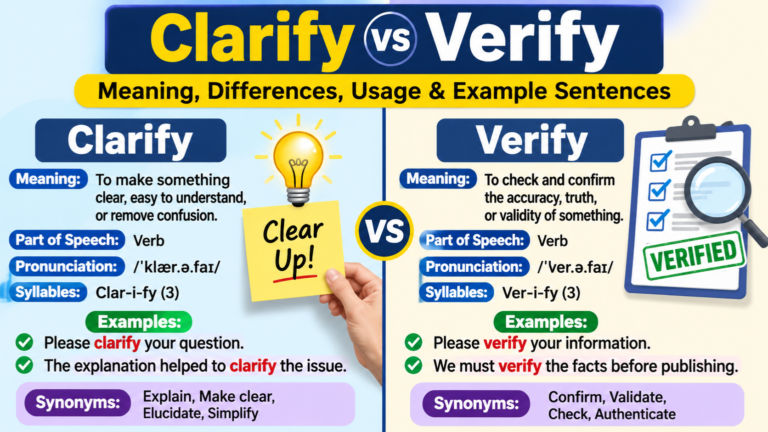
If you like clear word comparisons, try clarify vs verify, which separates two verbs that people often swap.
Want more? Browse all of our Vs comparison guides, explore the Spelling category, or read the latest posts on the ClearPenPress blog.
Frequently Asked Questions About Schema vs Scheme
Is schema the same as scheme?
No. The two words share a Greek root, but they have different jobs. Schema means a structure or framework. Scheme means a plan, arrangement, or plot.
Which is correct for a database: schema or scheme?
Schema. A database schema describes the tables, columns, and data types. “Database scheme” is a mistake.
What is schema markup?
Schema markup is structured data added to a web page to label its content for search engines. Google says structured data for Search mainly uses the schema.org vocabulary and generally recommends the JSON-LD format.
What does scheme mean in a URL?
In a web address, the scheme is the part before the colon, such as https or mailto. It tells software how to interpret the rest of the address.
What is the plural of schema?
The plural is schemas or schemata. Both are correct. Schemas is more common in everyday writing.
How do you pronounce schema and scheme?
Schema is SKEE-muh, and scheme is SKEEM. Both start with a “k” sound, not “sh.”
Is scheme always negative?
No. It can be neutral, as in a pension scheme or a color scheme. It sounds negative when it means a secret or dishonest plan, as in a fraud scheme.
Can scheme be a verb?
Yes. Scheme is also a verb: She schemed to get ahead. Schema is not used as a verb.
What is schema theory?
Schema theory explains how people organize knowledge into mental frameworks. It is linked to F. C. Bartlett and Jean Piaget, and it says new information is compared with existing schemas.
What is the difference between a color scheme and a color schema?
Color scheme is the standard term for a set of colors that work together. “Color schema” is not standard and should be avoided.
Which should I use in SEO: schema or scheme?
Use schema. The correct SEO terms are schema markup and schema.org.
Which word is more common in everyday English?
Scheme is more common in daily life, in phrases like color scheme, pension scheme, and savings scheme. Schema appears mostly in technical and academic writing.
Key Takeaways
Remember these rules for Schema vs Scheme:
- Use schema for frameworks, models, and structures.
- Use scheme for plans, systems, and programs.
- A database has a schema, not a scheme.
- Designers create color schemes, not color schemas.
- Only scheme works as a verb.
- Both words begin with a “k” sound, not “sh.”
Final Thoughts
The Schema vs Scheme choice is easier than it first looks. Use schema when you mean structure: a database schema, a mental schema, or schema markup. Use scheme when you mean a plan or arrangement: a pension scheme, a color scheme, a rhyme scheme, or a plot. Remember that only scheme can be a verb, that schema has two plurals, schemas and schemata, and that both words trace back to the same Greek root.
When in doubt, apply the substitution test: if framework fits, write schema; if plan fits, write scheme.
Memory tip: Schema = structure. Scheme = strategy.